An ASL Perspective: Be Careful How We Evaluate and Label Deaf Children
By Mark Drolsbaugh

It happened again. I thought it was amazing last year, but this one was even better. The Pennsylvania School for the Deaf recently hosted its second annual ASL Literature Contest, and in the process showed how brightly its students can shine.
Sixty students participated in the contest, in which they each had to present an ASL poem, skit or story. Some of the students did the ever-popular ABC storytelling, in which each sequential sign utilized a handshape corresponding with the letters of the alphabet. Others told stories in which they used the same handshapes repeatedly to convey a story. A few others made up dramatic routines which reflected their favorite movies or superheroes. What with the many diverse routines, it was a fascinating show.
What really struck me, however, was the amount of confidence radiating from practically all of the students. We had become used to seeing many of them acting shy, withdrawn, and unwilling to have the spotlight on them; as professionals, we often attribute that to language delays, inaccessible environments, communication problems at home, and so on.
Yet with the ASL contest, all of that dissipated. These kids were now on their home turf, standing on stage in front of a schoolwide audience, using the language which comes most naturally to them. Basically, they got up there and kicked some major league butt.
One of the kids who won first place in his age division was a child who notoriously shuts down during educational or psychological evaluations. In my opinion, many of these “standard” tests do nothing more than evaluate children from a white, hearing, American, middle-class perspective.
And this particular child, described by outside medical professionals as “shy” and “withdrawn”, was standing there on stage making 150 people laugh with his prize-winning comedy routine. He did it in ASL, the language which allows him to show people what he’s really made of.
The reason I bring this up is, quite obviously, the fact that we all need to be careful in how we evaluate and label deaf children. Not long ago, I went through a confusing experience in the middle of one student’s evaluation process.
One of my duties as school counselor is to write social-history (background) reports for incoming students. I was halfway finished writing such a report on a four-year-old boy when I ran into a roadblock.
During the initial enrollment interview, this boy was an angel. He was cooperative, playful, and demonstrated a wonderful sense of humor. As he went off to be evaluated by our staff, I continued interviewing this boy’s mother to be sure I had all the information that was needed. At one point during our discussion, we were interrupted by a speech/communication teacher who simply had to tell the boy’s mother what a great kid he was. The boy breezed through his evaluation and was an absolute joy to be with. Other evaluators, at one point or the other, echoed these sentiments.
Obviously, this was going to be an easy background report to write. “Great kid. Four years old. Loves everybody. No problem. End of report.” It was a piece of cake, until I stumbled onto his previous evaluation. In order to make sure I had the correct medical information, I checked his previous file from another agency… and was shocked at what I found. This same kid was described as “impulsive”, “withdrawn” and “not willing to socialize with others.” Did I make a mistake somewhere? Was this boy kidnapped by aliens and replaced with a friendlier duplicate of himself? What happened?
I was frustrated. I was so sure I had a complete, thorough report… and there I was holding a copy of another report which said the exact opposite of everything I’d written. This needed to be cleared up fast. After checking and double-checking, the answer finally appeared. At the agency where they did the first evaluation, NO ONE USED SIGN LANGUAGE. Duh! Of course the kid didn’t do what they asked him to… he didn’t understand a word they said.
Troubled, I posted this topic on an internet bulletin board and asked other deaf people for their feedback. The response was interesting. One person said a doctor once labeled him “antisocial” and “violent”, all because he couldn’t understand the questions the doctor asked him. Another person said that the psychological tests she took focused entirely on the hearing perspective. As she puts it, “all of the terms, questions, etc, represented hearing people… naturally, some of the things went off the chart because of this.”
People, we really need to be careful here. Yes, evaluations can be very important, but even more important are the evaluators themselves. Are they deaf-friendly? Do they sign? Are they able to accurately determine strengths and weaknesses? It’s definitely not easy. So we need to be careful in how we label deaf children.
Several years ago, Michael Jordan abruptly retired from basketball and decided to try his luck at baseball. It was a valiant effort, but he never made it to the big leagues. Several coaches commended his desire and perseverance, but the truth was obvious: Jordan had joined baseball too late, was too far behind, and in all likelihood was a longshot to ever play for the Chicago White Sox.
Suppose there was a baseball coach who didn’t know anything about basketball.
Suppose this coach had his head stuck in the sand so much that he never knew what Jordan had accomplished in basketball. At that point in time, Jordan had won three NBA championships and several MVP awards (not to mention Jordan still had the ability to go back and win some more, which he would later do).
But suppose, for the sake of argument, we had a baseball coach who was totally oblivious to all of Jordan’s basketball exploits. Suppose this coach had to write an evaluation of Jordan? It would go like this:
“Great work ethic, but doesn’t really understand the game. Started too late, will probably never catch up. Can’t hit the curve ball. Needs to focus on his footwork in the outfield… doesn’t understand the nuances of playing good defense. Very competitive, but this guy will never be a pro athlete.”
You get my drift… you just don’t ask a baseball guy to evaluate Michael Jordan as an athlete. For on the basketball court, he’s the greatest athlete in the world.
Likewise, with deaf children… if someone is evaluating them, that person needs to be aware of, and understand, the beautiful world of ASL and Deaf Culture.
For on stage that one day at PSD, we had sixty ASL versions of Michael Jordan drawing raucous rounds of applause.
See you next month!
— Mark Drolsbaugh, © 1998
Related stories

Deafinitely Our Life!
Romantic Valentine’s Day Dinner: Cooking with Chef Eagle
Chef Eagle
Deafinitely Our Life!
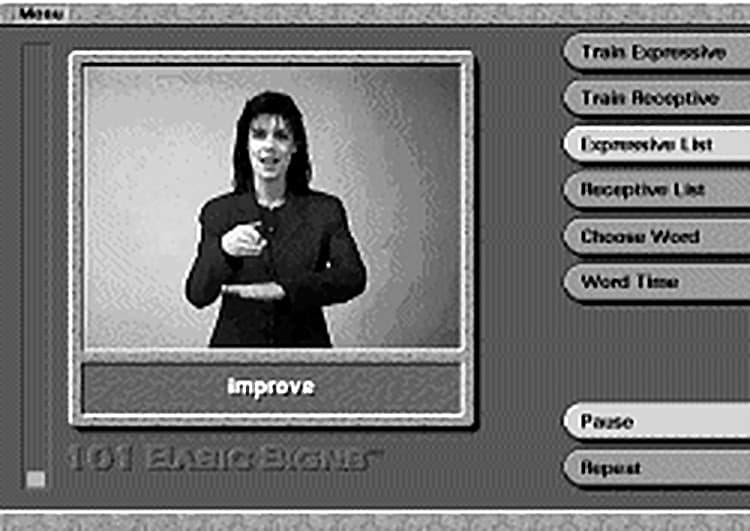
Review: ‘101 Basic Signs’ CD-ROM
Review by Leslie Grimm

Deafinitely Our Life!
The Isolation Myth — Debunked, Big Time
Mark Drolsbaugh
Deafinitely Our Life!
Spotlight on Agencies: Abused Deaf Women’s Advocacy Services — ADWAS
Margaret Bell, DeafNation Newspaper

Deafinitely Our Life!
Deaf Interior Designer Creates Comfortable Home Environments
Damara Goff Paris, DeafNation Newspaper